
In one of Europe’s most beautiful capital cities, students can spend four weeks studying urban history and sustainability in Edinburgh, Scotland. Students can earn OHIO credits on this faculty-led program.

Geography Department
Geography Department
Geography is the study of the Earth's landscapes, peoples, places and environments. It is, quite simply, about the world in which we live.
Geography students are interested in the spatial patterns observed on Earth. Bridging the natural and social sciences, geographers study how people interact with the environment, with emphasis on critical topics such as environmental sustainability, equity and social justice, climate change, globalization, and gender and development.
9
Undergraduate majors, including meteorology, pre-law and urban planning
2 + 3
2 graduate degrees, an M.S. and an M.A., plus 3 certificate programs
GIS
Programs offered for both graduate and undergraduate students
Exploring Earth's Peoples, Places and Environments
Geography faculty are productive scholars and excellent teachers committed to their students. Teaching and research interests include environment and society, globalization and development, landforms, ecological and atmospheric systems, and geospatial techniques such as GIS and remote sensing.
Regional specializations include Africa, East Asia, Latin America, and Northern Europe, with six faculty conducting research overseas.
Research Areas We Focus On
-
Environmental and Social JusticeUsing nature-society frameworks and spatial analysis to understand how inequality and inequity are built into everyday life.
-
Sustainability and PlanningExamining the strategies for balancing environmental quality, economic development, and social equity.
-
Globalization and DevelopmentExploring global issues and other parts of the world to better understand our own in an increasingly globalizing world.
-
Earth's Physical SystemsExamining atmospheric, ecological, and landform systems, how they change through time, and how they interact with each other.
-
Earth Observation and GISRevolutionizing how we explore the geography of places, cultures, environments and processes.
-
Cities, Places and RegionsUnderstanding the nature of places and delimiting regions, analyzing spatial differentiation across the Earth’s surface.
Geography Student Experiences — Here and Abroad
Explore urban environments in Scotland or forecast the weather in the Scalia Lab. Just a few ways to get hands-on experience in geography.
-
Study Climate Change, Conservation & Environmental Justice in Kenya
Geography students study the intertwined challenges of climate change and conservation confronting rural communities in Kenya.
-
Take Advantage of a Geography Internship
Most geography students complete at least one internship to get experience in the field and build up their resume with real-world work. You can also earn credits through GEOG 4910 Internship.
-
Conduct Undergraduate Research with a Professor
Whichever undergraduate major you choose, there are plenty of opportunities to earn course credit for individualized or directed research under supervision of a faculty member.
-
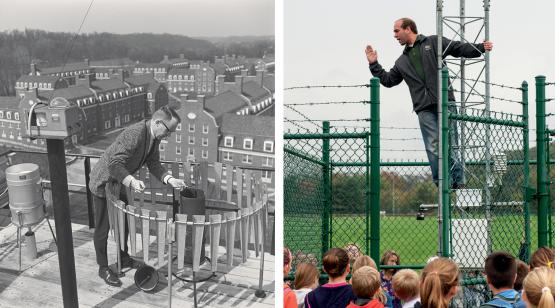
Forecast the Weather for Southeastern Ohio at the Scalia Lab
The Scalia Lab weather service gives students hands-on forecasting experience. Students provide several forecasts per day tailored to the people living in southeastern Ohio.
In a Nutshell: Dr. Ryan Fogt
From Athens to Antarctica, Ryan Fogt navigates worlds of weather and learning
Library of Congress Great Reads Selects Dr. Tim Anderson's Book
He co-edited 'Settling Ohio: First Peoples and Beyond'
Geography Students Gain Summer Internship Experience
These experiences span urban planning, sustainability, environmental geography and meteorology, allowing students to apply their academic knowledge to real-world situations.
Careers with a Geography Degree

Alumni Engagement & Giving Opportunities

Latest News
View All Department of Geography News
Geography

Geography Events
There are no events to show at this time.