Ohio University - Home
Apply Online Now!
Search
Ohio.edu Sites
Name Directory
 Students Faculty/Staff Alumni Parents
 Academics Research Offices Athletics The Arts Map/Tour
Department of Chemistry and Biochemistry
 
Graduate Studies
Undergraduate Studies
Faculty and Staff
Chemistry Facilities
Seminars
Contact Us
News Archives
Photos
Chemwatch
undefined
home_sub-nav-bottom
Faculty Search, Department of Chemistry and Biochemistry

The Department of Chemistry and Biochemistry at Ohio University invites applications for a tenure-track faculty member at the Assistant/Associate Professor level position with research interests in the area of biochemistry.  The candidate should have a Ph.D. in chemistry and significant postdoctoral experience.

 Applicants must apply online at www.ohiouniversityjobs.com and upload a cover letter, curriculum vitae, description of research interests, and statement of teaching experience/philosophy.  Each applicant must also arrange to have three letters of recommendation sent to 2009 Search Committee, Department of Chemistry and Biochemistry, Clippinger Laboratories, Ohio University, Athens, OH 45701-2979 or emailed to khurshid@ohio.edu.   

Review of applications will begin immediately and continue until the position is filled.  Further information on the position, and the department can be found at http://www.ohio.edu/chemistry/

Ohio University places a high priority on the creation of an environment supportive of the promotion of women, minorities, veterans, and persons with disabilities.


Chemistry Placement Exam

The placement exam will be offered at 4pm Tuesday through Thursday,  May 26th - May 28, in Clippinger Labs, Room 194.

Please read the requirements and more information here


Chemical chameleons: Color-changing molecules could be used for sunglasses, military applications
jeffrack
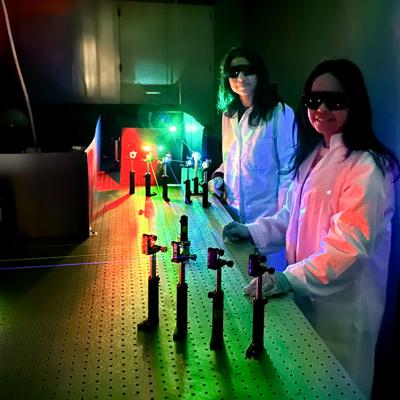
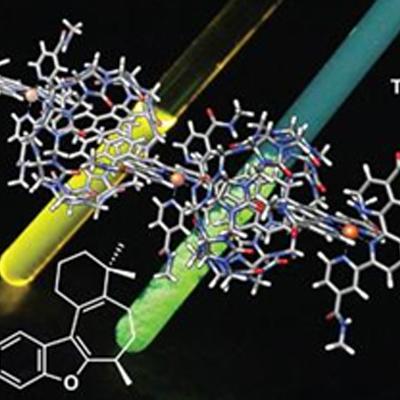
In a third-floor lab in Ohio University’s Clippinger Laboratories, chemistry isn’t black and white. It’s purple, red, yellow, orange and — depending on the type of laser — even peach.

With the support of a $315,000 grant from the National Science Foundation, an Ohio University research team is studying the ability of certain molecules to absorb light and change color at heightened speeds.

More..
 
Learning Together for Success

Join a Chemistry Learning Community.

Read the complete article here


2008 Research & Creative Activity Expo winners

Chemistry & Biochemistry was well represented in several areas.

Read the complete Outlook article here

 
New study sheds light on how bodies decompose indoors 
stain
While examining the scene of a 30-year-old death, Ohio University researcher Glen Jackson and colleagues discovered adipocere – fatty acids primarily made up of calcium salts – in a dry, airy building. Until this study, researchers had reported finding this evidence of human decomposition only in moist, anaerobic environments, such as when bodies are stored for extended periods in grave sites or submerged in water, he said.

More..
 
NSF Award

Assistant Professor in Chemistry and Biochemistry Awarded NSF CAREER Award

Dr. Glen P. Jackson, Assistant Professor in the Department of Chemistry and Biochemistry, has been awarded a $562,000 National Science Foundation (NSF) CAREER Award for his project titled “Mass Spectrometry for the Masses.”

According to the NSF website, CAREER Awards are “the most prestigious awards in support of the early career-development activities of those teacher-scholars who most effectively integrate research and education within the context of the mission of their organization.”      More information can be found at The Ohio University Outlook article.
 
undefined   An article from the group of Assistant Prof. Glen P. Jackson is featured on the cover of the April issue of Journal of the American Society for Mass Spectrometry. The primary author is third year graduate student Ünige A. Laskay.
    
According to Dr. Jackson, “Tandem mass spectrometers such as ours are frequently used in biomedical research to identify the proteins involved with certain gene functions or disease states. We have modified the software of a commercial instrument to enable the mass spectrometer to fragment the molecules in a unique manner. There are several benefits, such as enhanced speed, and of course a few downsides to this new approach. This paper focuses on understanding and optimizing this new fragmentation method so that we will know how to best apply the method to larger biomolecules.”

The article is titled: "Dynamic Collision-Induced Dissociation (DCID) in a Quadrupole Ion Trap Using a Two-Frequency Excitation Waveform: I. Effects of Excitation Amplitude and Phase Angle" and can be read at the following link. (http://dx.doi.org/10.1016/j.jasms.2006.12.008)

Department of Chemistry and Biochemistry
Clippinger Laboratories
Athens, OH 45701-2979
Tel: 740-593-1737 | Fax: 740-593-0148
chemistry@ohio.edu
All Rights Reserved