Ohio University Contemporary History Institute
 
site links
home page link
the program link
the faculty page
the courses link
the students link
sponsored events link
financial aid link
admission link
site links


the faculty page

The Contemporary History Institute’s faculty associates are drawn primarily from the departments of History, Economics, and Political Science and the School of Journalism. But faculty from other schools and departments also participate in Institute activities. A complete list of faculty associates would include some 34 individuals; but the following list suggests the range of faculty expertise that is available in our program:

Donald A. Jordan

Patrick Barr-Melej is Associate Professor of History, with a PhD from the University of California at Berkeley. He specializes in modern Latin America. His research focuses on the political and cultural history of 20th century Chile. Dr. Barr-Melej also has been a visiting professor in the history graduate programs at Chile's Pontifical Catholic University and University of Conceptción.

John Brobst is Associate Professor of History, with a PhD from the University of Texas at Austin. He specializes in the history of the British Empire and international security affairs. He is the author of The Future of the Great Game: Sir Olaf Caroe, India's Independence, and the Defense of Asia (2004). His current project is a forthcoming book entitled A New Order Sea Power: Britain, the United States, and the Reconstruction of Empire in the Indian Ocean, 1956-1971.

Alfred E. Eckes, Ohio Eminent Research Professor in Contemporary History. Professor Eckes is a graduate of the Fletcher School of Law and Diplomacy and the University of Texas at Austin. He served as chairman of the U.S. International Trade Commission and is President of the International Trade Commission Historical Society. Dr. Eckes’s books include: A Search for Solvency: Bretton Woods and the International Monetary System (1975); The United States and the Global Struggle for Minerals (1979); and Opening America’s Market: U.S. Foreign Trade Policy Since 1776 (1995). He is co-author of U.S. Trade Policy: History, Theory, and the WTO (1998), Revisiting U.S. Trade Policy (2000), and Globalization and the American Century (2003).

Marvin Fletcher, Professor of History. Professor Fletcher received his doctorate from the University of Wisconsin, and teaches courses on U.S. military history. His publications include The Black Soldier and Officer in the United States Army, 1891-1917 (1974); The Peacetime Army, 1900-1940: A Bibliography (1988); and America’s First Black General: Benjamin O. Davis, Sr. (1989).

William H. Frederick, Associate Professor of History. Professor Frederick studied at Yale University and at the University of Hawaii. He specializes in recent Southeast Asian history and is the author of Visions and Heat: The Making of the Indonesian Revolution (1989). He is currently writing a book-length study of violence in the Indonesian Revolution.

Norman J. W. Goda is Associate Professor of History and Chair of the Department of History. He holds a Ph.D. from the University of North Carolina at Chapel Hill, and teaches courses on European international relations. Dr. Goda’s book, Tomorrow The World: Hitler, Northwest Africa, and the Path Toward America was a History Book Club selection. He is presently completing a book entitled Tales from Spandau: Cold War Diplomacy and the Nuremberg War Criminals. He has also worked closely with a US government Interagency Working Group that is reviewing millions of still-classified US government documents on Nazi Germany and Nazi war criminals. A book based on the project, US Intelligence and the Nazis, which Goda co-authored with fellow consultants Richard Breitman and Timothy Naftali, has been published in separate editions by Cambridge University Press and the National Archives.

Michael Grow, Associate Professor of History. Professor Grow studied at the University of Wisconsin and received his Ph.D. from George Washington University. He teaches courses in Latin American history and U.S.-Latin American relations and is the author of The Good Neighbor Policy and Authoritarianism in Paraguay (1981) and a Scholar’s Guide to Washington, D.C. for Latin American and Caribbean Studies (rev. ed., 1992). His current book project - Intervention as Imagery: U.S. Presidents and the Overthrow of Latin American Governments in the Second Half of the 20th Century - is under contract with the University Press of Kansas.

Alonzo L. Hamby, Distinguished Professor of History. A graduate of the University of Missouri, Professor Hamby specializes in 20th century U.S. history, especially politics and culture. His books include: Beyond the New Deal: Harry S. Truman and American Liberalism (1973); The Imperial Years: The United States since 1939 (1976); Liberalism and Its Challengers: F.D.R. to Reagan (2d ed., 1992); Man of the People: A Life of Harry S. Truman (1995), and For the Survival of Democracy: Franklin Roosevelt and the World Crisis of the 1930s (2004).

Katherine Jellison, Associate Professor of History. A graduate of the University of Iowa, Professor Jellison teaches courses in U.S. women’s history. She has written Entitled to Power: Farm Women and Technology, 1913-1963 (1993) and is currently working on a book-length study of the commercialization of American weddings.

Donald A. Jordan, Professor of History. Professor Jordan holds a Ph.D. from the University of Wisconsin, and teaches courses on the history of China and Japan. His books include The Northern Expedition: China’s National Revolution of 1926-1928 (1976); Chinese Boycotts Versus Japanese Bombs: The Failure of Chinese Revolutionary Diplomacy, 1931-32 (1988); and China’s Trial by Fire: The Shanghai War of 1932 (2001).

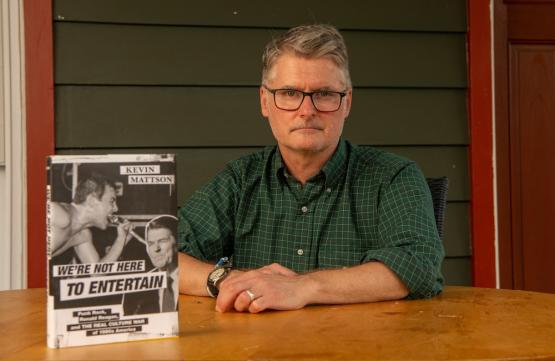
Kevin Mattson is Connor Study Professor of Contemporary History at Ohio University. His work examines the intersection between politics and the world of ideas. He is author of numerous books including Rebels All!: A Short History of the Conservative Mind in Postwar America (2008, forthcoming); Upton Sinclair and the Other American Century (2006); When America Was Great: The Fighting Faith of Postwar Liberalism (2004, 1st edition, 2006, 2nd edition); Engaging Youth: Combating the Apathy of Young Americans Towards Politics (2003); Intellectuals in Action: The Origins of the New Left and Radical Liberalism, 1945-1970 (2002); and Creating a Democratic Public: The Struggle for Urban Participatory Democracy During the Progressive Era (1998). Additionally, he is co-editor with Neil Jumonville of Liberalism for a New Century (2007); Steal This University! (2003); and Democracy’s Moment (2002). He has written essays on a variety of topics for the New York Times Book Review, The Washington Post Book World, The Nation, The American Prospect, Common Review, The Baffler, and Chronicle Review. He has also appeared on Fox News, German Television, PBS, and NPR. He is presently an affiliated scholar at the Center for American Progress (based in Washington, D.C.), active in the American Association of University Professors (AAUP), and on the editorial board of Dissent magazine. His website is: http://oak.cats.ohiou.edu/~mattson/

Steven M. Miner, Professor of History and Director of the Contemporary History Institute, studied at King’s College, London, Rice University, and Indiana University. He is a specialist in recent Russian/Soviet and East European history. His first book, Between Churchill and Stalin: The Soviet Union, Great Britain, and the Origins of the Grand Alliance (1988), won the American Historical Association’s 1991 George Louis Beer prize for the best book of the year in European history. His latest book is Stalin’s ‘Holy War’: Religion, Nationalism, and Alliance Politics, 1941-1945 (2003). He is currently at work on a documentary study of the 1934 murder of Sergei Kirov, to be published in the Yale University Press “Archives of Communism” series, and a history of the Soviet Union in World War II, to be published by HarperCollins and Bloomsburg.

Harold Molineu, Professor of Political Science, received his doctorate at American University. He is a specialist on U.S. foreign policy and U.S.-Latin American relations, and is the author of U.S. Policy Toward Latin America: From Regionalism to Globalism, 2d ed. (1990).

Chester J. Pach, Jr., Associate Professor of History and director of the Department of History's graduate programs, received his Ph.D. from Northwestern University and teaches recent U.S. history and U.S. foreign relations. His books include Arming the Free World: The Origins of the United States Milidary Assistance Program, 1945-1950 (1991); and The Presidency of Dwight D. Eisenhower (rev. ed., 1991). He is currently finishing a book entitled The First Television War: TV News, the White House, and Vietnam, a project for which he received a grant from the National Endowment for the Humanities. He also has a contract with the University Press of Kansas to write The Presidency of Ronald Reagan.

Takaaki Suzuki, Associate Professor of Political Science and director of the Department of Political Science's graduate program, holds a Ph.D. from Columbia University. He is a specialist in modern Japanese politics and is the author of Japan’s Budget Politics: Balancing Domestic and International Interests (2000).

Richard K. Vedder, Distinguished Professor of Economics. Dr. Vedder completed his graduate work at the University of Illinois. He has published extensively in the field of U.S. economic history, including: The American Economy in Historical Perspective (1976); Variations in Business and Economic History (1982); Poverty, Income Distribution, the Family and Public Policy (1986); and, as coauthor, Out of Work: Unemployment and Government in Twentieth-Century America (1997).

Thomas W. Walker, Professor of Political Science. A graduate of Brown University and the University of New Mexico, Professor Walker is one of the United States’ leading authorities on Central American politics. His books include: The Christian Democratic Movement in Nicaragua (1970); Nicaragua: The Land of Sandino (3d ed., 1991); Nicaragua in Revolution (1982); Nicaragua: The First Five Years (1985); Reagan Versus the Sandinistas: The Undeclared War on Nicaragua (1987); and as coauthor, Understanding Central America (2d ed.; 1993); Revolution and Counterrevolution in Nicaragua (1991); and Nicaragua Without Illusions: Regime Transition and Structural Adjustment in the 1990s (1997).

Patrick S. Washburn, Professor of Journalism. Professor Washburn received his doctorate from Indiana University and has been a newspaper reporter and columnist. He is the author of A Question of Sedition: The Federal Government’s Investigation of the Black Press during World War II (1986), and is currently writing a book for Oxford University Press on the press and the government in World War II. He is also the editor of the academic journal Journalism History.

Patricia A. Weitsman, Professor of Political Science, received her Ph.D. from Columbia University in 1994 and has been a fellow at the Graduate Institute of International Studies in Geneva, Switzerland as well as the Hoover Institution at Stanford University. She is co-author of The Politics of Policy Making in Defense and Foreign Affairs, co-editor of Towards a New Europe and Enforcing Cooperation. Her most recent book, Dangerous Alliances, was published by Stanford University Press in 2004. She is also the author of numerous articles and book chapters published in prominent books and journals in the field of international relations. She is currently working on a short monograph on coalition warfare, as well as a larger project on war and identity.

welcome | the program | the faculty | the students
the courses | sponsored events | financial aid | admission