
"My PAL Leader helped me to not be so intimidated by the coursework and expectations of the class and my major. She made the materials digestible and easy to understand."- PAL participant
Peer-Assisted Learning (PAL)
Peer-Assisted Learning (PAL)
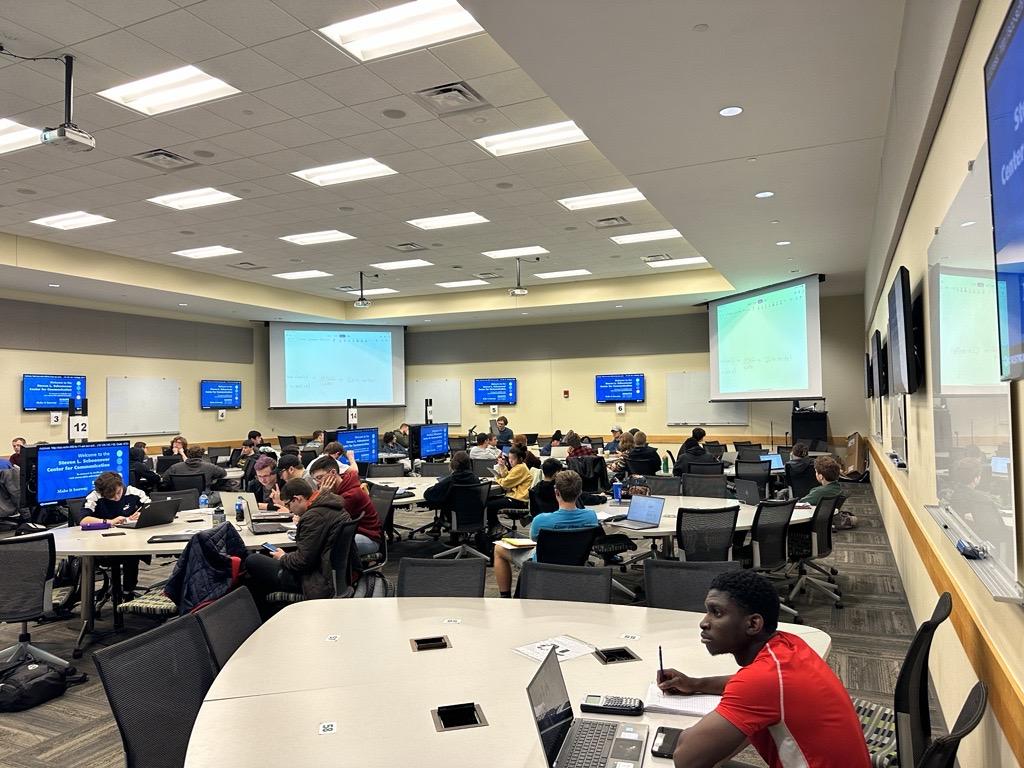
Peer-Assisted Learning (PAL) is a series of weekly study sessions for students taking historically difficult courses at our university. PAL sessions are facilitated by students (PAL Leaders) who have already taken and done well in the course.
PAL Leaders will guide you through class material in an environment where you are working with other students to discuss important concepts, compare notes, develop strategies for studying the subject, and test each other before you are actually tested by your professor.
PAL is based on the Supplemental Instruction model, which was developed by Dr. Deanna Martin in 1973 at the University of Missouri at Kansas City, designed to increase student retention and academic performance. The program has been at Ohio University for more than 20 years and has proven successful in these areas.
Our data shows that students who regularly attend PAL earn, on average, 1/2 to 1 whole letter grade higher than non-PAL participants.
How PAL Works
PAL Leaders will contact students directly from class rosters to indicate that PAL is available for a course and to provide guidance on how to participate.
Courses & Schedule - Fall 2026 Schedule
| Subject | Course Number | PAL Leader | PAL Session Days & Times | Location |
|---|---|---|---|---|
| Accounting | ACCT 1010 | Lily Johnston | Tuesday at 6 PM Wednesday at 5 PM | Copeland 020 |
| Biological Science | BIOS 1030 - Professor Mammone | Hannah Kloppman | Monday at 7 PM Tuesday at 7 PM | Walter 245 |
BIOS 1030 - Professor Van Brocklyn | Evan Kosht | Tuesday at 6 PM Thursday at 7 PM | Walter 235 | |
BIOS 1030 - Professor Moss | Surcha Weir | Monday at 6 PM Wednesday at 5 PM | Ellis 003 | |
BIOS 1300 | Meredith Brown | Monday at 6 PM Tuesday at 6:30 PM | Walter 145 | |
| Caroline Pinson | Wednesday at 6 PM Sunday at 2 PM | |||
BIOS 1700 | Lucian Lopez | Monday at 5 PM | Porter 100 | |
| Paige Herfurth | Tuesday at 6:30 PM | |||
| Lucian Lopez | Wednesday at 5 PM | |||
| Paige Herfurth | Thursday at 5:30 PM | |||
BIOS 1710 | Emilee Heilmann | Monday at 6 PM Wednesday at 5 PM | Walter 245 | |
BIOS 3010/3015 | Raodat Sarker | Monday at 4:30 PM Wednesday at 4:30 PM | Irvine 194 | |
BIOS 3100 | Ellie Stanek | Monday at 7 PM Wednesday at 5 PM | Alden 322 | |
| Chemistry | CHEM 1205 | Ava Hershberger | Monday at 7 PM | Walter 145 |
| Amanda Evans | Tuesday at 5:15 PM | |||
| Ava Hershberger | Wednesday at 7 PM | |||
| Amanda Evans | Thursday at 6 PM | |||
CHEM 1500 | Olivia Went | Monday at 7:30 PM Tuesday at 5:30 PM | Ellis 114 | |
CHEM 1510 | Tina Nguyen | Tuesday at 5 PM Thursday at 6 PM | Ellis 014 | |
CHEM 1520 | Riya Jacob | Monday at 6 PM Thursday at 5 PM | Ellis 014 | |
CHEM 3050 | Anna McCabe | Tuesday at 5 PM Thursday at 6 PM | Alden 322 | |
CHEM 3060 | Gabriel Leach | Monday at 6 PM Wednesday at 6 PM | Alden 322 | |
| Computer Science | CS 2400 | Divine Mbabazi | Monday at 5:45 PM Thursday at 5:45 PM | ARC 106 |
| Engineering | ET2240 | Katie McGivern | Monday at 5 PM Thursday at 5 PM | Irvine 110 |
| Math | MATH 1200 | Jenna Klein | Monday at 5:30 PM | Morton 127 |
| Ali Ruple | Tuesday at 7 PM | |||
| Jenna Klein | Wednesday at 6 PM | |||
| Ali Ruple | Thursday at 5:30 PM | |||
MATH 1300 - Math Sections | Liam Owen | Monday at 5 PM | Ellis 003 | |
| Max Roback | Tuesday at 6:30 PM | |||
| Max Roback | Wednesday at 6 PM | |||
| Liam Owen | Thursday at 5 PM | |||
| MATH 1300 - Engineering Sections | Abbi Wells | Tuesday at 6:30 PM Wednesday at 6 PM | ARC 102 | |
MATH 1350 | Charli Kulka | Monday at 7:15 PM | Morton 415 | |
| Luke Mullins | Tuesday at 5:30 PM | Morton 222 | ||
| Charli Kulka | Wednesday at 8:15 PM | Morton 415 | ||
| Luke Mullins | Thursday at 7 PM | Morton 222 | ||
MATH 2301 - Engineering Sections | Molly Robinson | Monday at 5 PM Wednesday at 5 PM | ARC 102 | |
MATH 2301 - Math Sections | Hannah Pawlikowski | Tuesday at 5 PM Thursday at 6:15 PM | Morton 219 | |
MATH 2302 - Engineering Sections | Haydon Barrera | Monday at 6 PM Thursday at 6:30 PM | ARC 102 | |
MATH 2302 - Math Sections | Brody Dinan | Tuesday at 6:15 PM Thursday at 5 PM | Morton 219 | |
| Physics | PHYS 2001 | Annalise Hulec | Monday at 5:30 PM Wednesday at 5:30 PM | Ellis 114 |
PHYS 2002 | Ryan Tatman | Tuesday at 5 PM Thursday at 5 PM | Walter 245 | |
| Psychology | PSY 1110 - Professor Tice-Alicke | Lindsey Wallace | Tuesday at 6 PM Thursday at 6 PM | Ellis 006 |
PSY 1110 - Professor McCarthy | Emma Hesson | Tuesday at 5:30 PM Thursday at 6 PM | Ellis 003 | |
PSY 2110 | Emma Bostedo | Monday at 5 PM Tuesday at 6 PM | Walter 245 |
Student Testimonials
- "I benefitted from PAL sessions because they helped motivate me to study more. I did not do well on my first quiz in the class but after I began to attend PAL somewhat regularly my grades improved tremendously."
- "It was awesome having a more in-depth discussion about the topics while they were still fresh in my mind. [The PAL Leader] did a great job of facilitating those discussions, was always prepared with handouts despite her hectic schedule, was always cheerful and kept the session light and fun, and covered a large amount of material, breaking sections into individual, small group, and class work."
- "It was a comfortable environment to learn."
- "Going to PAL truly helped me learn these math skills not just temporarily, but in a long-term way. I couldn't have made it through without the help of my wonderful leader."
- "PAL brought my grade up 20%."
- "I feel that PAL really helped my grade in the course this semester. On my first exam, I failed. I started going to PAL and got a C+ on my second exam."
Peer-Assisted Learning FAQ
I’ve been asked to include Peer Assisted Learning (previously called Supplemental Instruction or SI) with my class. What does that mean for me?
Collaboration between the PAL leader and instructor is important and allows Peer Assisted Learning to attain its highest potential effectiveness for our students. The time commitment for instructors is minimal, usually less than 30 minutes a week. Instructor responsibilities are simply to communicate with the PAL Leader, provide resources as needed and endorse. Instructors are not expected to prepare materials or attend the PAL Sessions. More information about what can be expected from an instructor in a PAL partnership is as follows:
Communication
- PAL leaders sit in on class (as their schedule allows) and are encouraged to communicate on a weekly basis with instructors. It is up to the Instructor and the PAL Leader whether these communications happen in meetings or via email – it is whatever works best for the instructor. If the instructor prefers meetings, they can be scheduled during office hours, or at a time that works for both the instructor and PAL leader. PAL leaders will keep the instructor appraised of what is happening in the sessions, inform on questions students are asking about, point out areas where the students are struggling, discuss the level of class participation, and offer advance review of session materials and study guides.
Resources
- Instructors are asked and encouraged to share resources with PAL leaders at their discretion. Examples of resources are syllabus, handouts, practice tests, course textbooks, online course materials, etc. This will allow the PAL leader to be appropriately prepared for their PAL sessions.
Promotion and Endorsement of PAL
- During the first week of classes, instructors are asked to allow the PAL leader a couple of minutes to introduce themselves to the class, explain what PAL is, and invite students to attend the PAL sessions.
- Every few weeks, instructors allow the PAL leader to make subsequent announcements, reminding students that PAL is available, the day(s) and times of sessions and letting the students know of upcoming exam reviews.
- Instructor periodically makes announcements reminding students about PAL and including the information on PAL and sessions in course announcements. The instructor should endorse PAL for all students, not just those who are struggling. This helps to eliminate the stigma that only those who are failing the course should attend. The combination of high-and low performing students in PAL sessions provides a collaborative and less threatening environment, where students learn from each other in a more intimate setting.
As you can see, the time involved and work commitment for instructors is minimal, but the results can be immense. Data shows that students at Ohio University who attend 10 or more PAL sessions a semester can get a full letter grade higher than if they don’t attend PAL. PAL provides a valuable resource for both student and instructor.