Ohio University - Home
Apply Online Now!
Search
Ohio.edu Sites
Name Directory
 Students Faculty/Staff Alumni Parents
 Academics Research Offices Athletics The Arts Map/Tour
Department of Chemistry and Biochemistry: Faculty & Staff
 
Graduate Studies
Undergraduate Studies
Faculty and Staff
Chemistry Facilities
Seminars
Contact Us
By Name
By Area of Study
By Area of Study
Graduate Assistants
undefined
Photo Coming Soon
Kenneth L. Brown
 
Contact Information
Office Location:Clippinger Laboratories
Phone Number:740-517-0564
Fax Number:740-593-0148
E-Mail Address:brownk3@ohio.edu
 

Professor
Ph.D., University of Pennsylvania
Utilizing biophysical techniques in understanding the enzymology of coenzyme B12 -dependent enzymes

 
Courses Taught
Course NameQuarter Offered
Chem 151: Fundamentals of Chemistry I
Fall, Winter, Summer I


Information

For some time now, our research has concentrated in the area of the chemistry of vitamin B12 and its derivatives, as well as the chemistry of simpler model cobalt chelates capable of stabilizing carbon-cobalt bonds, the unique feature of the biologically active forms of vitamin B12. While the topic of our research is thus bioinorganic (as well as organometallic) in nature, our point of view is decidedly physical organic, as we are interested in the mechanism by which carbon-cobalt bonds are formed and cleaved, the thermodynamics and kinetics of axial ligand substitution pro­cesses, and the association of B12 derivatives with proteins, as well as the mechanisms by which enzymes "activate" the coenzyme form of vitamin B12 by inducing the cleavage of its carbon-cobalt bond. 

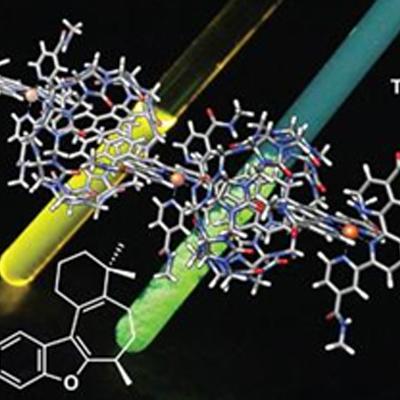
 Molecule

     One current thrust involves our observations of facile axial ligand diastereomerism on alkylation of cobinamides (B12 derivatives lacking the axial nucleotide) with a variety of alkyl halides. We are studying mechanisms of isomerization and the thermodynamics and kinetics of these reac­tions to try to address the questions of kinetic vs equilibrium control of products. 

     We are also studying thermally induced carbon-cobalt cleavage reactions in organocobalt derivatives of vitamin B12. We are trying to understand steric and inductive ef­fects of axial ligands on these reactions as well as the presumably steric basis for the lability of secondary and bulky primary organocobalt derivatives. These experiments are de­signed to provide chemical background for eventual understanding of the enzymatic "activation" of the coenzyme

form of vitamin B12. 

     Recently, we have developed a force field for the cobalt corrinoids and have used molecular mechanics cal­culations to address important questions of conformation and conformational equilibria in biochemically active derivatives of vitamin B12. Currently, these methods are being advanced by the application of NMR distance restraints to molecular dynamics calculations which will permit the discovery of solution conformations and the three dimensional structures of B12 derivatives which stubbornly refuse to crystallize and cannot be studied by X-ray crystallography. 

     We are also currently studying the coenzyme B12-dependent enzyme ribonucleotide reductase (RTPR) from Lactobacillus leichmannii . Recently, stopped-flow kinetic measurements of the "activation" of coenzyme B12 have allowed determination of the activation parameters for the enzyme-induced cleavage of the carbon-cobalt bond. Comparison to the activation parpmeters for the non-enzymatic thermal cleavage of this bond shows that the enzyme lowers the enthalpy of activation by some 15 kcal mol-1 in order to catalyze the reaction. Studies of the NMR properties of 13C and 15N labeled coenzyme B12 with this, and other B12-dependent enzymes are also in progress, along with studies of the structure and enzymology of structural analogs of coenzyme B12, some of which are partially active coenzymes and some of which are inhibitors. 

     A number of structural analogs with altered Ado ligands are partially active coenzymes for RTPR and some other AdoCbl-dependent enzymes. Examples include the interesting IsoAdoCbl, in which the N-glycosidic bond is to the adenine N3 instead of N9, and the carbocyclic analog aristeromycyl-cobalamin (AriCbl) (Fig. 1). We are trying to structurally characterize such analogs, as well as some which are coenzymatically inactive, in order to understand the structural determi­nants which lead to activity. 

     A significant body of evidence suggests that the bulky lower 5,6-dimethylbenzimidazole axial ligand, is important in catalysis either by sterically destabilizing the ground state, or by electronically stabilizing the transition state for Co-C bond homolysis. We intend to study these so-called mechanochemical triggering mechanisms by determining the enzymatic and non-enzymatic reactivity of analogs with altered lower axial ligands, including benzimidazole (Ado(Bzim)Cbl), and imidazole (Ado(Im)Cbl) (Fig. 1). 

 
Selected Publications

Molecular Mechanics and Molecular Dynamics Simulations of Porphyrins, Metalloporphyrins, Heme Proteins and Cobalt Corrinoids. Marques, H. M.: Brown, K. L. Coord. Chem. Rev. 2002, 225, 123-158.

Functions of the D-Ribosyl Moiety and the Bulky Axial Ligand of the Nucleotide Loop of Coenzyme B12in Diol Dehydratase and Ethanolamine Ammonia-lyase Reactions. Fukuoka, M.; Yamada, S.; Miyoshi, S.; Yamashita, K.; Yamanishi, M.; Zou, X.; Brown, K. L.; Toraya, T. Journal of Biochemistry 2002, 132, 935-943.

Probing the Nature of the Co(III) Ion in the Cobalamins: Kinetics of the Ligand Substitution Reactions of Iodocobalamin and the Deactivation of the Metal Towards Ligand Substitution in 10-Nitrosoaquacobalamin. Marques, H. M.; Knapton, L.; Zou, X.; Brown, K. L. J. Chem. Soc., Dalton Trans. 2002, 3195-3200 ().

Detailed Kinetic and Thermodynamic Studies on the Cyanation of Alkylcobalamins. A Generalized Mechanistic Description. Hamza, M. S. A.; Zou, X.; Brown, K. L.; vanEldik, R. J. Chem. Soc., Dalton Trans 2002, 3832 - 3839.

Probing the Nature of the Co(III) Ion in the Cobalamins: The Reaction of Aquacobalamin (vitamin B12a) with Ambidentate Nucleophiles Perry, C. B.; Fernandes, M. A.; Brown, K. L.; Zou, X.; Pearson, N. R.; Marques, H. M. Eur. J. Inorg. Chem. 2003, 136, 2095-2107.

Kinetic and Thermodynamic Studies on the Cyanation Reactions and Base-on/Base-off Equilibria of Alkyl-13-epicobalamins Hamza, M. S. A.; Zou, X.; Brown, K. L.; van Eldik, R. Dalton Trans. 2003, 2986-2991.

Thermodynamic and Kinetic Data for the Base-on/Base-off Equilibration of Alkylcobalamins. Hamza, M. S. A.; Zou, X.; Brown, K. L.; van Eldik, R. Eur. J. Inorg. Chem. 2003, 268-276.

Solution Structure, Enzymatic, and Non-enzymatic Reactivity of 3-Isoadenosylcobalamin, a Structural Isomer of Coenzyme B12 with Surprising Coenzymic Activity. Brown, K.L.; Zou, X.; Chen, G.; Xia, Z.; Marques, H. M. J. Inorg. Biochem. 2004, 98, 287-300.

Low Temperature Dehydrogenation of a-Indolene Nucleosides. Chandra, T.; Zou, X.; Brown, K. L. Tetrahedron Lett. 2004, 45, 7783-7786.

Solution Structure and Thermolysis of Coβ-5'-Deoxyadenosylimidazolylcobamide, a Coenzyme B12 Analog with an Imidazole Axial Nucleoside.  Brown, K. L.; Zou, X.; Banka, R. R.; Perry, C. B.; Marques, H. M. Inorg. Chem. 2004, 43, 8130-8142. 

Product Stabilization in the Enzymatic Activation of Coenzyme B12:  A Molecular Modeling Study.  Brown, K. L.; Marques, H. M. J. Mol Struct. THEOCHEM 2005, 714, 209-215. 

Regioselective Glycosylation:  Synthesis of α-Indoline Nucleosides.  Brown, K. L.; Chandra, T.; Zou, X.; Valente, E. J. Nucleosides Nucleotides & Nucleic Acids, 2005, 24, 1147-1165. 

The Solution Structure of Some Cobalamins Determined by NMR-Restrained Molecular Modelling.  Perry, C. B; Brown, K. L.; Zou, X.; Marques, H. M. J. Mol. Struct. 2005, 737, 245-258. 

The Chemistry and Enzymology of Vitamin  B12.   Brown, K. L. Chem. Rev. 2005, 105, 2075-2150. 

Kinetic and thermodynamic studies on ligand substitution reactions and base-on/base-off equilibria of cyanoimidazolylcobamide, a vitamin  B12 analog with an imidazole axial nucleoside.  Hamza, M. S. A.; Zou, X.; Banka, R.; Brown, K. L.; van Eldik, R. Dalton Trans. 2005, 782-787. 

Direct Glycosylation:  Synthesis of α-Indoline Ribonucleosides. Chandra, T.; Brown, K. L. Tetrahedron Lett. 2005, 46, 2071-2074. 

Deprotection of α-Imidazole/Benzimidazole Ribonucleosides by Catalytic Carbon Tetrabromide Initiated Photolysis; Chandra, T.; Brown, K. L. Tetrahedron Lett. 2005, 46, 8617-8619. 

Cross Correlated Relaxation Between H1 Chemical Shift Anisotropy and H1-H2  Dipolar Relaxation Mechanisms in Ribonucleosides:  Application to the Characterization of their Anomeric Configuration.  Puchumani, K.; Chandra, T.; Zou, X.; Brown, K. L. .  J. Phys. Chem. B, 2006, 110, 5-8. 

The Enzymatic Activation of Coenzyme  B12.  Brown, K. L. Dalton Trans. 2006, 1123-1133. 

Regio- and Stereoselective Glycosylation:  Synthesis of 5-Haloimidazole α-Ribonucleosides.  Chandra, T. Zou, X. Valente, E. J.; Brown, K. L. J. Org. Chem., in press. 

Chemoselective Deprotection of α-Indole and Imidazole Ribonucleosides.  Chandra, T.; Brown, K. L., manuscript submitted to Nucleosides, Nucleotides & Nucleic Acids

A Method to Determine the Anomeric Configuration in Carbohydrates by 1H NMR Cross-correlated Relaxation Studies:  Application to D-Glucose and D-Mannose as Model Systems.  Puchumani, K.; Zou, X.; Chandra, T.; Brown, K. L., manuscript submitted to Chem. Phys. Lett. 

 
Back to top
Department of Chemistry and Biochemistry
Clippinger Laboratories
Athens, OH 45701-2979
Tel: 740-593-1737 | Fax: 740-593-0148
chemistry@ohio.edu
  
All Rights Reserved